From Pixels to Agentic AI
Video games have been the test lab for the AI future we’re stepping into. We’ve trained ourselves for decades on what it feels like to interact with “intelligent” systems, even when those systems were primitive by today’s standards.

By Todd Barron
Back in the 1990s, when I was developing games professionally, our AI wasn’t “intelligent” in the modern sense. It was coded in low-level language, rule-based, and quite predictable. But that predictability gave players the sense of fairness and challenge they craved. Enemies reacted logically because they had to. And let’s be honest; chaos wasn’t fun when your CPU was already struggling just to keep the world on screen. Pushing pixels was a very intensive process at the time.
Fast-forward to today, and technologies such as Unreal Engine have turned game AI into something far more flexible. Developers use Behavior Trees and the Environment Query System to create NPCs that don’t just follow scripts; they react within designer-defined rules. You can tell an NPC (Non-Player Character) to wander until something sparks their attention; when it does, the AI decomposes the situation into goals: find cover, approach the player, or retreat and regroup (Epic Games, n.d.-a; Epic Games, n.d.-b).
Generative AI raises the stakes. Replica Studios showed “smart NPCs” that generate unscripted dialogue in real time back in 2023 (Takahashi, 2023). Epic, meanwhile, announced a Persona Device for Unreal Editor for Fortnite in June 2025 so creators can build AI-powered NPCs that converse with players in-game (Epic Games, 2025a), which Epic also highlighted in its State of Unreal 2025 roundup (Epic Games, 2025b). And Convai has been rolling out tools that let NPCs co-create narrative with the player, guiding conversations toward goals without rigid dialogue trees (Convai, 2024).
AI also helps behind the curtain. Razer’s WYVRN platform includes an AI QA copilot aimed at automating bug detection and QA reporting for Unreal and Unity projects (Razer, 2025). Think of it as the QA team’s sleepless intern: always testing, never complaining.
Now layer in what agentic AI means. Artificial intelligence agents go beyond clever search and retrieval. They act. The newest systems can work across many channels at once; calling tools, kicking off workflows, collecting data, stitching context, and continuing until the job is done. That’s what “agentic AI” means in practice: not just answering, doing; and doing so persistently until the goal is met.
Picture it. An agent looks at the context of what you’re trying to do, sometimes on your behalf, sometimes proactively. It can find an item in the digital world, fetch it, and use it to make progress. And it keeps going; loop after loop; until it reaches the goal you set, or the goal implied by the rules it lives under.
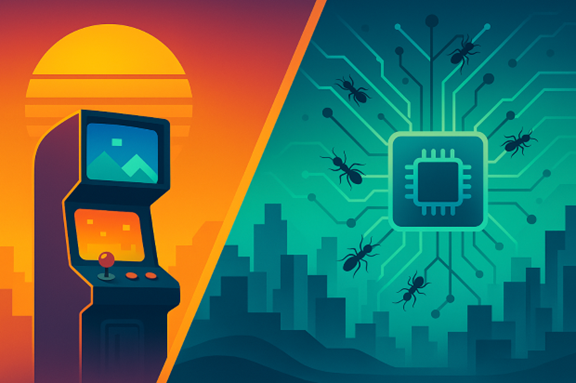
Now turn one agent into a team. Multiple agents can work together, like ants. Some scout for what’s needed. Some guard against threats like malware or account takeovers. Some do the hands-on work. Some build, they create artifacts and infrastructure, from documents and dashboards to data pipelines and pull requests. Coordinated this way, you get systems that learn and heal. They adapt to new conditions, recover from failure, and keep moving toward the objective you gave them at the start.
Here’s where it gets interesting. The same agent patterns we used in games for years; scouts, defenders, workers, builders; map cleanly to how companies are rolling out software agents today (with longer horizons and stricter constraints in the real world). In a game, a hunter stalks the player. In a warehouse, an agent stalks waste. Different stage, same choreography. The craft we used to make virtual worlds feel alive is the craft we need now.
In games, every character runs a simple rhythm: look, think, plan, do. Tight loop. Hard time limits. No excuses. Enterprise agents live on the same diet. They take in signals, update what they believe about the world, pick a goal, choose a step, and act. Then they check what happened and adjust. The surface changes, but the loop does not.
Game development taught us to keep a real world model. Not just feelings. Facts. Beliefs. Confidence in those beliefs. What did the character see? What is missing? What changed since last tick? Business agents need that same backbone. A short-term memory for what just happened. A long-term memory for what happened over time. Predictive metrics for what may happen. A belief state that endures across hours, days, and months, not just a single burst of inference.
Planning matters. We shipped behavior trees because we needed predictable control flow. We used goal-oriented action planning when the goal had many steps and many ways to get there. We leaned on hierarchical task networks when a big mission needed to break down into clean, testable chunks. Business agents face the same shape of work. “Reduce fraud losses this week” turns into “scan transactions across channels, forecast risk, step up verification or hold funds with rules for customer experience, compliance, and cost,” with graceful exits and recovery when the core banking system or the payment network is unavailable, or when a safety metric like false declines or approval rate moves out of bounds.
Pathfinding in games is choosing a good route under real limits (time, speed, hazards, etc.). We route around rivers and cliffs. In the enterprise, we route around privacy rules, rate limits, and budgets. Obstacles are different. The math is the same. Assign costs. Avoid traps. Reach the goal without blowing up the player’s trust or the company’s wallet.
We have been doing multi-agent AI work for years. Squads. Roles. NPCs. The same patterns run an organization. You have scouts that collect data. Defenders that enforce safety. Workers that execute steps. Builders that create lasting assets like documents, dashboards, or code. They coordinate through shared state and messages, just like characters share a logic graph or query their environment.
Shipped game intelligence is not magic. It is tooling and tests. We log decisions. We build sandboxes. We replay bugs. That discipline is how agents will earn trust at work. Clear traces. Reproducible scenarios. Decision graphs you can explain to a human who must sign off on the result. We often talk of AI as a black box but that is not acceptable. You must be able to trace key inputs, outputs, and decisions. Observability is required if users are ever to trust the machine.
Measurement matters too. In games, if you reward the wrong thing, players will notice and break it. In business, if you chase a single number, users will game it. Use more than one goal. Balance improvement with safety. Add guardrails that do not blink. When the policy says no, the agent should stop, explain, or escalate.
And the big question; artificial general intelligence (AGI.) If we ever get there in practice, it will not be a better large language model alone. It will be a solution stack that looks familiar to any game developer: a durable world model, a clear goal system, robust planners that can decompose work and recover from failure, perception that filters noise into structured signals, memory that ages and highlights what matters, and safety layers that enforce hard rules. Large language models give us language and broad knowledge. The reliable logic that makes complex goals happen under real-world limits still must be built. That is our craft.
Video games have been the test lab for the AI future we’re stepping into. We’ve trained ourselves for decades on what it feels like to interact with “intelligent” systems, even when those systems were primitive by today’s standards. Now that generative AI is in the mix, those lessons are becoming more real; and more impactful.
But this isn’t just about game logic. It’s also about the hardware that made it possible. Nvidia didn’t start as an AI company; it started in graphics in 1993 and became a leading supplier of discrete graphics processors for personal-computer gaming (Encyclopedia Britannica, 2024). The GeForce 256 (1999) was introduced as the world’s first “graphics processing unit,” rated for at least 10 million polygons per second; a milestone that helped make three-dimensional worlds feel immersive (Nvidia, 2024). Compute Unified Device Architecture (CUDA) arrived in 2006, opening general-purpose graphics computing and laying groundwork for today’s AI workloads (Nvidia, n.d.).
That relentless demand from gamers was a major driver; alongside high-performance computing, CUDA, and deep-learning breakthroughs; for the AI boom. Without it, graphics processors wouldn’t have evolved into the massively parallel engines that power modern AI training. The insatiable demand for more powerful gaming hardware led to Nvidia investing billions into research that helped enable modern AI.
Here’s the kicker: every time you maxed out frames in Quake or Half-Life, you were indirectly pushing the tech that fuels today’s AI revolution.
--
References
Convai. (2024). Conversational agents for games: Goal-guided, dynamic dialogue tools.
Encyclopedia Britannica. (2024). Nvidia.
Epic Games. (2025a). Persona Device for Unreal Editor for Fortnite (UEFN) announcement.
Epic Games. (2025b). State of Unreal 2025: Key announcements.
Epic Games. (n.d.-a). Behavior Trees: Authoring modular decision logic in Unreal Engine.
Epic Games. (n.d.-b). Environment Query System: Spatial reasoning for non-player characters.
Nvidia. (2024). GeForce 256: Product overview and historical specifications.
Nvidia. (n.d.). Compute Unified Device Architecture: Overview.
Razer. (2025). WYVRN platform: AI quality-assurance copilot announcement.
Takahashi, D. (2023). Replica Studios demonstrates “smart NPCs” with real-time, unscripted dialogue.
About the Author
Todd Barron has spent more than three decades building systems that think, learn, and adapt. He shipped his first commercial video game in 1991 and went on to lead work across software engineering, product development, data architecture, cloud, and artificial intelligence. His background in game AI and agent design shapes how he approaches modern enterprise AI. He focuses on creating patterns that scale, architectures that last, and guidance that teams can actually use. Todd writes about the realities of AI on http://Lostlogic.com and shares ongoing work and insights on LinkedIn: https://www.linkedin.com/in/toddbarron/