Architecture First. AI Second.

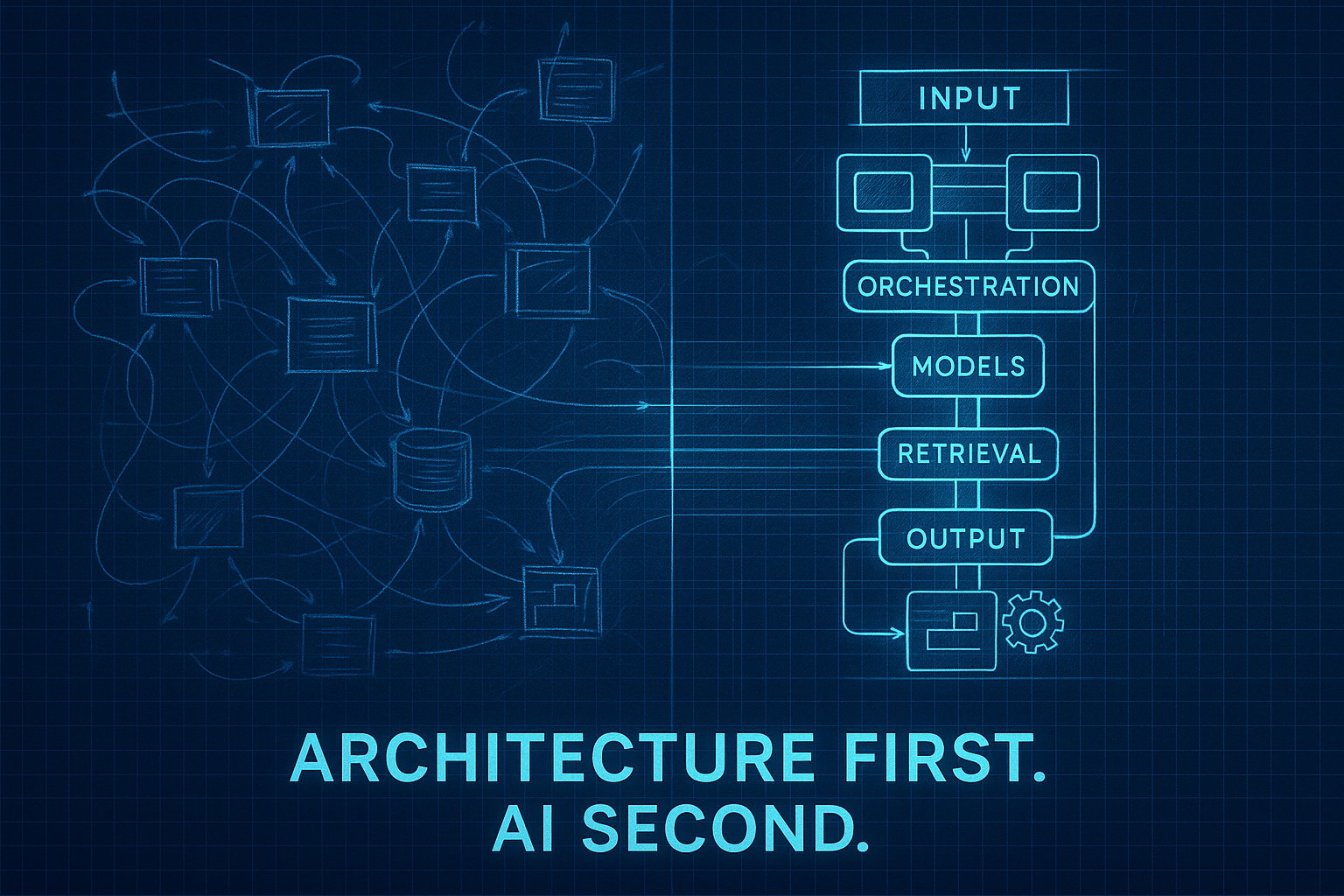
Let’s talk about something most enterprises are running into, but few are acknowledging.
Everyone is building AI.
Every team.
Every department.
People are putting together agents, copilots, automations, whatever they need to solve a problem.
And honestly, this is great. It shows curiosity and momentum.
But here’s the rub.
If you peel back the layers, almost none of these systems are built the same way.
Different frameworks.
Different retrieval patterns.
Different security assumptions.
Different integration approaches.
Different everything.
And because of that, the architecture behind enterprise AI is all over the place.
This is not about people doing something wrong.
It is about the organization not giving them a shared pattern to follow.
So, the question becomes: how do you guide an enterprise toward a unified AI architecture, especially when the teams building these systems are spread across the company?
Let’s double click on that.
The Architecture Fragmentation Problem
What do we see?
When you look inside most companies, you do not see one AI system.
You see dozens.
Some built internally.
Some quietly created in a department.
Some embedded inside vendor tools.
Some started as experiments and then never really stopped.
Few of them follow the same pattern.
Few of them use the same stack.
None of them integrate with data in the same way.
What happens?
You end up with a landscape where every system behaves a little differently.
Some are reliable.
Some are clever.
Some do great work.
But they do all of it in different ways.
And that inconsistency makes it hard to govern, hard to secure, and hard to evolve with intent.
Why Architecture Must Come First
Why does this matter?
You cannot bring stability to systems that all look different.
You cannot monitor drift if each agent is doing retrieval in its own way.
You cannot apply a comprehensive security model if each workflow uses different patterns.
You cannot assign ownership when there is no shared foundation.
Executives want trust, predictability, reliability, clarity.
Architecture is what gives them that.
Early experiments worked without architecture.
Scaling AI never does.
The Universal AI Architecture
Every AI system in an enterprise should be built around one singular pattern.
This is not a standard operating procedure but rather a standard operating guideline.
And even though it’s a guideline, it is key to success.
There is input.
There is an orchestration layer.
There are models.
There is memory.
There is a retrieval step to ground the model.
There is judgement and post processing.
There is output.
There is automation.
And there is logging and telemetry the entire time.
That is the pattern.
It is simple.
But it is powerful.
When every AI system follows this pattern, you get consistency.
You get clarity.
You get something you can observe, manage, and evolve.
Without this pattern, every AI system becomes its own custom build.
And that does not scale.
Standardizing Frameworks and Protocols
Standards are great as there are so many to pick from…. Don’t fall into this trap.
Once you define the architecture, you standardize how people build on top of it.
You pick one orchestration framework.
You pick one retrieval approach.
You define how prompts are structured.
You define how agents pass messages.
You define how memory works.
You define how errors are handled.
You define how versioning works.
You define how observability works.
You define what guardrails sit around the system.
Then you standardize the protocols.
One request pattern.
One response pattern.
One telemetry pattern.
One set of signals for drift.
One method for tracking cost, latency, and context usage.
This is what turns your AI environment into a real ecosystem instead of a collection of unrelated parts.
Unified Data Access and Retrieval
Don’t forget that without data, AI is nothing.
AI only works well when it is grounded in good information.
But if every team connects to data differently, the results will always vary.
You need consistent data access patterns.
Versioned APIs and Data.
Clear schemas.
One search or retrieval layer, or one abstraction that sits above distributed stores.
Shared tagging.
A common method for filtering and ranking information.
This gives every agent the same view of the truth.
It is table stakes.
The Platform Security Layer
Security means trust.
Security is not optional, and it should never be custom per agent.
If every team builds their own guardrails, you will get inconsistency.
You need one policy engine.
One redaction pipeline.
One PII detection layer.
One identity aware access control pattern.
One set of safety rules.
One monitoring layer that sees everything.
Security becomes a platform capability.
Not something people have to figure out every time they build an agent.
Architecture Enables Ownership
Clear ownership only works when the architecture is consistent.
A business owner needs a predictable system.
A technical owner needs a unified framework.
Drift detection only makes sense when every system logs and behaves the same way.
Trust metrics only matter when they are measured across the same architecture.
Architecture is what turns ownership into something real.
Without it, ownership becomes symbolic.
The Applied AI Platform Team
Every company that is serious about AI needs an Applied AI Platform Team.
This team does not build business features.
They build the foundation that everyone uses.
They own the architecture.
They maintain the frameworks.
They define the protocols.
They manage the retrieval layer.
They run the security layer.
They support the technical owners across the business.
They provide the stability and clarity that enterprise AI needs.
The AI Council’s Real Role
The AI Council is not a place where ideas get slowed down.
It is a place where ideas get aligned.
It connects the business to the platform.
It creates consistency across teams.
It ensures decisions are made with the full picture in mind.
And it keeps the AI ecosystem coherent as it grows.
What Can You Do NOW?
As a leader, what can you do now?
Invest in the architecture first.
Set the standards before scaling.
Designate a passionate Applied AI Leader.
Empower the platform team.
Require systems to follow the same architectural blueprint.
Bring clarity to how AI is built, governed, and evolved.
When the architecture is unified, everything becomes easier.
Building is easier.
Owning is easier.
Monitoring is easier.
Scaling is easier.
Closing
The real opportunity in enterprise AI is not only in the models.
It is in the architecture that connects them to the business.
When that architecture is unified, the entire organization moves with more confidence and more clarity.
Architecture does not slow teams down.
It clears the road and enables acceleration.
About the Author
Todd Barron has spent more than three decades building systems that think, learn, and adapt. He shipped his first commercial video game in 1991 and went on to lead work across software engineering, product development, data architecture, cloud, and artificial intelligence. His background in game AI and agent design shapes how he approaches modern enterprise AI. He focuses on creating patterns that scale, architectures that last, and guidance that teams can actually use. Todd writes about the realities of AI on http://Lostlogic.com and shares ongoing work and insights on LinkedIn: https://www.linkedin.com/in/toddbarron/